What do you use to seal screw holes in hardtop
2,132 views·13 replies·by Ftu209
A nice thick bead of 4200 or Boat Life Life Caulk would be my choice. If you use 5200 and have to remove the hailer later, be prepared to use piano wire as a saw, or maybe that adhesive remover that works occasionally.
Are you through-bolting, or just screwing down? Because if through-bolting, then there's really more you should do than just use some sealer under it. It gets complicated to do it right, which 80% of boat owners will not attempt.
Are you through-bolting, or just screwing down? Because if through-bolting, then there's really more you should do than just use some sealer under it. It gets complicated to do it right, which 80% of boat owners will not attempt.
CaptainOriginal Crew2,210 postsSince 2018

The critical question is, is the hardtop cored? If not a lot of sealers will be adequate. If it is you really should be looking at proper methods to install hardware. Even if what you use works right now, it will probably deteriorate over time. Once it does and the core gets compromised it can become a big issue.
CaptainOriginal Crew3,414 postsSince 2019
That de-coring thing is what I was alluding to . . . Not many want to or know how to tackle that procedure. Even though its not much of a biggie at all. Two-beer job, at the worst.
CaptainOriginal Crew2,210 postsSince 2018

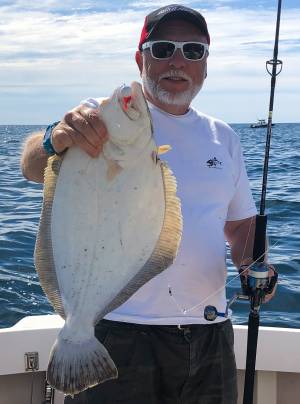
I use fluke farts. Gotta be FAST to catch those!
CaptainOriginal Crew2,210 postsSince 2018
White eels. . . A.k.a.: “Coney Island Whitefish”
CaptainOriginal Crew2,210 postsSince 2018
I use fluke farts. Gotta be FAST to catch those!
Cod farts are a real thing. Funny when you bring one up and there's a bunch of bubbles coming out of his butt. Even funnier when you release one and you can track his escape route by bubbles, kind of like watching a scuba diver swimming away from you...
AdmiralOriginal Crew21,694 postsSince 2018
F
Is it really complicated and I've been doing it the wrong way? I thought the objective was to drill a hole larger than what you wanted to pass through with a hole saw, fill the hole with epoxy (with tape on the bottom to hold it in until set), then drill through the center of the epoxy with the exact diameter of what needs to pass. I've never had a problem with that, but I'm no fiberglass expert.
MateOriginal Crew85 postsSince 2019

Is it really complicated and I've been doing it the wrong way? I thought the objective was to drill a hole larger than what you wanted to pass through with a hole saw, fill the hole with epoxy (with tape on the bottom to hold it in until set), then drill through the center of the epoxy with the exact diameter of what needs to pass. I've never had a problem with that, but I'm no fiberglass expert.
It becomes even easier if you use a hole saw (from the top) and after you break through the top skin you remove the pilot drill then drill down through the core but not through the lower skin. Fill the hole with glass infused resin and done. That way there is no fixing up the holes on the underside. There it took me longer to explain that than to do it. 😛
CommodoreOriginal Crew5,182 postsSince 2018
Old Mud has it right - and so does Roccus7 . . . 😈
For small screws that is the best method. For larger holes, like for flush-mounted rod holders for instance, I've used a finishing nail bent at a right angle in my trusty Makita drill to CAREFULLY de-core the wood sandwiched between the inner and outer fiberglass "skins." Then a mix of epoxy resin and some filler - cabosil or even fine wood
dust from a table saw added to the resin until it reaches peanut butter consistency, in order to fill the void created. Once hardened, a quick filing job to remove any circular inconsistency to the hole, and good to go. Of course there are always at least three if not four screws holding that rod holder in the gunnel, so those should be attended to as well. To do it "right," that is.
But guess what? Almost no one ever does this job correctly. My observations is that 99% of flush rod holders just get jammed into a hole-sawed gunnel, a bead of silicone sealer and that's that. In fact, again, from what I've seen, if they're factory-installed, the bead of sealer isn't even used. And I've seen that on some VERY expensive (like multi-$100K) fishing rigs.
For small screws that is the best method. For larger holes, like for flush-mounted rod holders for instance, I've used a finishing nail bent at a right angle in my trusty Makita drill to CAREFULLY de-core the wood sandwiched between the inner and outer fiberglass "skins." Then a mix of epoxy resin and some filler - cabosil or even fine wood
dust from a table saw added to the resin until it reaches peanut butter consistency, in order to fill the void created. Once hardened, a quick filing job to remove any circular inconsistency to the hole, and good to go. Of course there are always at least three if not four screws holding that rod holder in the gunnel, so those should be attended to as well. To do it "right," that is.
But guess what? Almost no one ever does this job correctly. My observations is that 99% of flush rod holders just get jammed into a hole-sawed gunnel, a bead of silicone sealer and that's that. In fact, again, from what I've seen, if they're factory-installed, the bead of sealer isn't even used. And I've seen that on some VERY expensive (like multi-$100K) fishing rigs.
CaptainOriginal Crew2,210 postsSince 2018
Sign in to reply to this thread.