Peconic Bay Scallops Parasite Surprise
This year’s die-off of Peconic Bay scallops was Found to have an undetected parasite that can infect the kidneys of adult and juvenile scallops.It looks like folks were caught off guard here. “This is a new factor that scientists think may have a prevalent effect,”
The specific parasitic organism, known as coccidian parasite, was discovered in kidney tissue of all scallops collected and sampled from Shelter Island’s Hay Beach last November. Some scallops had “extensive damage” to renal tubes, enough to kill the most heavily infected.
Scientists at Stony Brook University’s Marine Animal Disease Laboratory, said the parasite “represents a significant threat” to the scallops. Biologists last year theorized a combination of factors may have spurred the collapse of Peconic Bay scallops, which saw mortality rates of from 90% to 100%. But no one saw this coming.
Originally we heard that is was the unusually warm waters and resulting low oxygen levels may have hit at the height off the scallops’ summer spawning season in July, putting heightened stress on the shellfish. There were also reports that large schools of cow-nosed rays spotted in eastern waters may have been feasting on scallops. Thanks at guess was wrong.
My fear it’s that the scallops go the way of the lobster population in the Long Island Sound. In the prior two years, baymen landed some 108,000 pounds of bay scallops with value of some $1.6 million. This winter, many licensed scallopers put away their gear after just a week and lost a good piece of their annual income.
Stony Brook scientists would continue to investigate “environmental factors that promote disease development of the parasite and monitor its geographical extent in bay scallops in Peconic Bay in order to protect and restore this ecologically and economically important resource.”
This sounds exactly like what we heard about our lobster fishery. You know the 4 million pound a year fishery that has all but left the Sound. Similar to the collapsed lobster fishery that we still have no definitive answer for, DEC is still referring to the cause of the die-off as “unknown,”
I don’t have all of the answers why, but it seems clear to me things are changing in our bays and we need to get a hold of it before it’s too late.
Killer Paraste Found In Peconic Bay Scallops.
1,138 views·6 replies·by george
Very interesting George, I had heard this last night, but your post has provided me with a project for today. A quick literature source revealed a 1994 article from Prince Edward Island discussing a then as yet "unknown" coccidian protozoan infection in the renal tissue of bay scallops, Argopectin irradians.
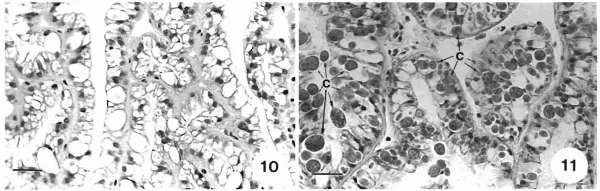
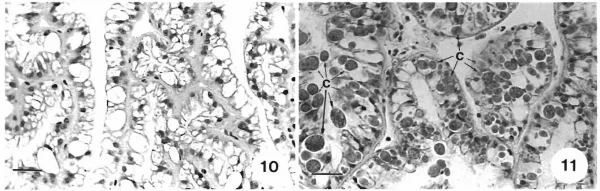
Anyway the paper I found had an interesting histology photo of the beastie in scallop renal tissue. Panel 10 is the control, the microscopic picture of healthy, scallop renal tissue. The only dark round things there are the nuclei of the renal cells. In Panel 11, a picture of infected scallop renal tissue, there are other "dark spots" marked "C", coccidian protozoan infecting the tissue. The renal tissue in 11 also shows damage, but that not easily discerned to the untrained eye especially in this small photo. It took me a few minutes to figure that out n a much enlarged photo.
So far I have not seen anything identifying the exact species of the current LI infection. I'd hazard a guess that SB and DEC are working on it, but this is very "Good, Bad New". At least unlike the lobster die off, there IS a smoking gun here so instead of making wild stabs in the dark, the identification of the causative agent should will enable a concerted effort to see what steps can be taken to get the fishery back on track.
Anyway the paper I found had an interesting histology photo of the beastie in scallop renal tissue. Panel 10 is the control, the microscopic picture of healthy, scallop renal tissue. The only dark round things there are the nuclei of the renal cells. In Panel 11, a picture of infected scallop renal tissue, there are other "dark spots" marked "C", coccidian protozoan infecting the tissue. The renal tissue in 11 also shows damage, but that not easily discerned to the untrained eye especially in this small photo. It took me a few minutes to figure that out n a much enlarged photo.
So far I have not seen anything identifying the exact species of the current LI infection. I'd hazard a guess that SB and DEC are working on it, but this is very "Good, Bad New". At least unlike the lobster die off, there IS a smoking gun here so instead of making wild stabs in the dark, the identification of the causative agent should will enable a concerted effort to see what steps can be taken to get the fishery back on track.
AdmiralOriginal Crew21,694 postsSince 2018
Very interesting George, I had heard this last night, but your post has provided me with a project for today. A quick literature source revealed a 1994 article from Prince Edward Island discussing a then as yet "unknown" coccidian infection in the renal tissue of bay scallops, Argopectin irradians. For the record, coccidians are round bacteria. Some "nasties" that you may be familiar with that are round include Streptococcus, Pneumococcus, Staphylococcus, etc.I was hoping for a Roccus reply here. Hopefully they'll get to the bottom of it before it's too late.
DISCLAIMER - Just because this guy is a Coccidian (round) bacterium, it doesn't mean it's related to any of the above nasties I mentioned, Coccidians are just a structure grouping, not a true taxonomic grouping. Please don't go off telling folks that Strep killed their scallop dinner this year!!!
Anyway the paper I found had an interesting histology photo of the beastie in scallop renal tissue. Panel 10 is the control, the microscopic picture of healthy, scallop renal tissue. The only dark round things there are the nuclei of the renal cells. In Panel 11, a picture of infected scallop renal tissue, there are other "dark spots" marked "C", coccidian bacteria infecting the tissue. The renal tissue in 11 also shows damage, but that not easily discerned to the untrained eye especially in this small photo. It took me a few minutes to figure that out n a much enlarged photo.
View attachment 15374
So far I have not seen anything identifying the exact species of the current LI infection. I'd hazard a guess that SB and DEC are working on it, but this is very "Good, Bad New". At least unlike the lobster die off, there IS a smoking gun here so instead of making wild stabs in the dark, the identification of the causative agent should will enable a concerted effort to see what steps can be taken to get the fishery back on track.
CommodoreOriginal Crew5,158 postsSince 2018
Crap, I can't find any other papers on bay scallop renal protozoan infections. If that continues, looks like the folks on PEI noticed something, but nobody speciated the infectious coccid and that was the end of it.
Regrettably I can no longer access better scientific libraries without paying $$$. My next step would normally be going into the Citation Index to see where that PEI paper was cited. That would have given me a trail of papers to look at.
Oh well. But as I mentioned above, there seems to be a smoking gun so there is a concrete starting point instead of the usual "Damned if we know"...
Regrettably I can no longer access better scientific libraries without paying $$$. My next step would normally be going into the Citation Index to see where that PEI paper was cited. That would have given me a trail of papers to look at.
Oh well. But as I mentioned above, there seems to be a smoking gun so there is a concrete starting point instead of the usual "Damned if we know"...
AdmiralOriginal Crew21,694 postsSince 2018
I had heard (right or wrong) that what played a major factor in killing off the Lobster Fishery in the Sound was connected to the spraying of tidal areas to kill off mosquitoes during the West Nile scare.
My understanding (again - right or wrong) was that insects. crabs & lobsters all share the same type of metabolism or some such thing. So what kills the bigs - kills the crabs & lobsters (i.e. crabs & lobsters are basically big bugs).

My understanding (again - right or wrong) was that insects. crabs & lobsters all share the same type of metabolism or some such thing. So what kills the bigs - kills the crabs & lobsters (i.e. crabs & lobsters are basically big bugs).
Lobster die-off linked to pesticides (2003)
The Connecticut Post, Saturday, March 08, 2003 Lobster die-off linked to pesticides. Fishermen applaud scientific finding. By MARIAN GAIL BROWN. mgbrown@ctpost.com BRIDGEPORT – Scientific dat…
nospray.org
AdmiralOriginal Crew20,900 postsSince 2018

>
I had heard (right or wrong) that what played a major factor in killing off the Lobster Fishery in the Sound was connected to the spraying of tidal areas to kill off mosquitoes during the West Nile scare.
My understanding (again - right or wrong) was that insects. crabs & lobsters all share the same type of metabolism or some such thing. So what kills the bigs - kills the crabs & lobsters (i.e. crabs & lobsters are basically big bugs).
[URL unfurl="true"]https://nospray.org/lobster-die-off-linked-to-pesticides-2003/[/URL]
And your analogy has too do with Peconic bay Scallops how
I had heard (right or wrong) that what played a major factor in killing off the Lobster Fishery in the Sound was connected to the spraying of tidal areas to kill off mosquitoes during the West Nile scare.
My understanding (again - right or wrong) was that insects. crabs & lobsters all share the same type of metabolism or some such thing. So what kills the bigs - kills the crabs & lobsters (i.e. crabs & lobsters are basically big bugs).
[URL unfurl="true"]https://nospray.org/lobster-die-off-linked-to-pesticides-2003/[/URL]
And your analogy has too do with Peconic bay Scallops how
AdmiralOriginal Crew40,955 postsSince 2018
>
so take it down if it's bothering you that much
Not bothering me but the thread about Peconic bay scallops not something you might of heard from Onacock or Google about stuff in the Noreast that has being said for yrs But this aint about the lobstass
so take it down if it's bothering you that much
Not bothering me but the thread about Peconic bay scallops not something you might of heard from Onacock or Google about stuff in the Noreast that has being said for yrs But this aint about the lobstass
AdmiralOriginal Crew40,955 postsSince 2018
CORRECTION: Turns out I was screwing up my "beasties", assuming that this "coccid" was a bacterium, but that is incorrect. It's a protozoan, you know those cool things like amoebas and paramecia you saw in a microscope you watched in HS Biology... I edited all the above to correct this faux pas.
AdmiralOriginal Crew21,694 postsSince 2018
Sign in to reply to this thread.