2nd wind developer moves to terminate its contracts off Martha's Vineyard SouthCoast Wind Cancels 1,200 MW Offshore Project Off Martha's Vineyard, Agrees to Pay $60M Termination Fee
Date: August 31, 2023
SouthCoast Wind, an offshore wind developer, announced on Tuesday its decision to abandon initial plans for a 1,200-megawatt installation in the waters off Martha’s Vineyard. The company has agreed to pay a $60 million termination fee to utility companies, signaling the official collapse of its existing contracts.
The penalty breakdown includes $32.4 million for Eversource, $27.3 million for National Grid, and $591,000 for Unitil, as per amendments filed with the Department of Public Utilities. These utility companies are set to credit the payments back to ratepayers through future contract adjustments.
This announcement comes after months of SouthCoast Wind warning that the project had become financially unfeasible due to shifting economic trends. The move echoes Commonwealth Wind, another developer that received approval last week to terminate its own offshore wind contract. Both developers intend to submit new bids in the next state solicitation, aiming for higher project valuations.
Pending approval from the Department of Public Utilities, the termination will bring down the state’s already-approved offshore wind energy capacity from 3,200 megawatts to just 800 megawatts. The Healey administration aims to secure between 400 and 3,600 megawatts in the next bidding round, in alignment with Massachusetts' clean energy law, which requires 5,600 megawatts of offshore wind power by 2027.
First reported by CommonWealth Magazine, the termination agreement awaits the green light from state regulators. If approved, this would be a significant development, raising questions about the future pricing and viability of offshore wind projects in the region.
George R. Scocca george@nyangler.com www.nyangler.com - Your Secret Spot Online !
Shorty for the delayed updates. It's all happening so fast we can't keep up.
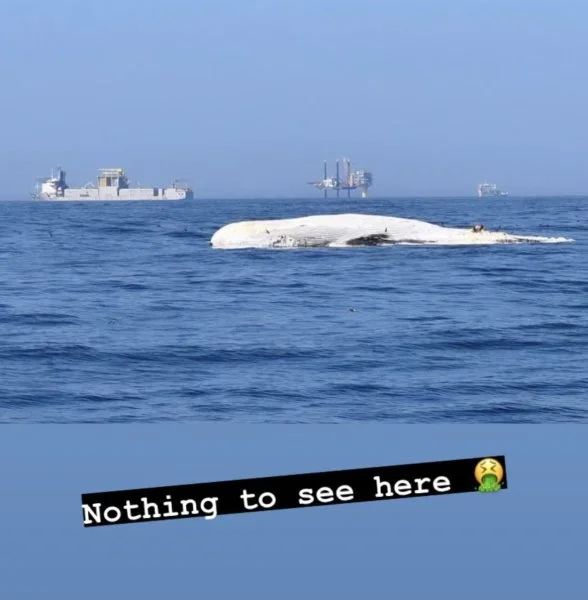
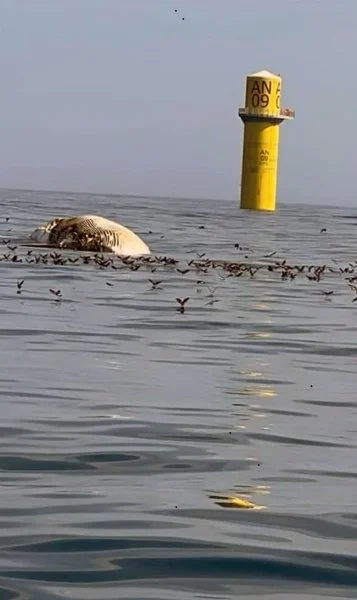
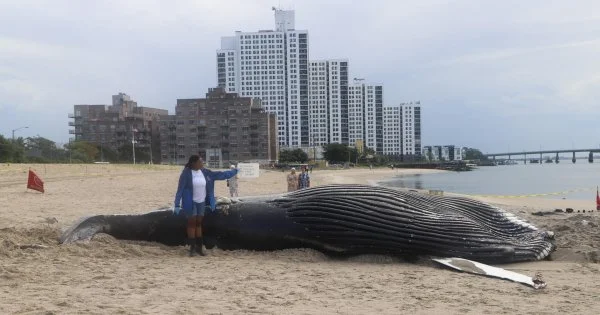
These two dead whales make it a total of 6 in NJ food the month of August.
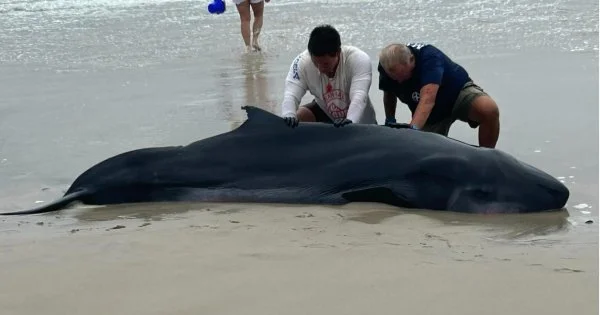
This is the 6th confirmed whale to wash ashore living or deceased, or reported floating offshore for the month of August. Earlier today, 8/29, a whale (species not yet confirmed), washed ashore LoveLadies Beach north of Coast Avenue on Long Beach Island, NJ.
#ICYMI On Friday evening, 8/25, a deceased humpback whale washed ashore Rockaway Beach, NY. For updates regarding this whale, and preliminary necropsy results, please visit @Atlantic Marine Conservation Society's social media pages.
We as people must stay vigilant and not allow these excessive deaths to be normalized.
Photo 1 Description: Pygmy sperm whale, washed ashore Long Beach Island, NJ on 8/29
Photo Credit: Local Resident from Long Beach Island
Photo 2 Description: Humpback whale, washed ashore Rockaway Beach, NY on 8/25
Photo Credit: @Atlantic Marine Conservation Society
#whales
George R. Scocca george@nyangler.com www.nyangler.com - Your Secret Spot Online !
Could their overzealous greed and disregard for the environment and the ocean's wildlife actually wind up becoming our salvation? We can hope for this conclusion but also must keep the pressure on as everyone here mentions!
2nd wind developer moves to terminate its contracts off Martha's Vineyard SouthCoast Wind Cancels 1,200 MW Offshore Project Off Martha's Vineyard, Agrees to Pay $60M Termination Fee
Date: August 31, 2023
SouthCoast Wind, an offshore wind developer, announced on Tuesday its decision to abandon initial plans for a 1,200-megawatt installation in the waters off Martha’s Vineyard. The company has agreed to pay a $60 million termination fee to utility companies, signaling the official collapse of its existing contracts.
The penalty breakdown includes $32.4 million for Eversource, $27.3 million for National Grid, and $591,000 for Unitil, as per amendments filed with the Department of Public Utilities. These utility companies are set to credit the payments back to ratepayers through future contract adjustments.
This announcement comes after months of SouthCoast Wind warning that the project had become financially unfeasible due to shifting economic trends. The move echoes Commonwealth Wind, another developer that received approval last week to terminate its own offshore wind contract. Both developers intend to submit new bids in the next state solicitation, aiming for higher project valuations.
Pending approval from the Department of Public Utilities, the termination will bring down the state’s already-approved offshore wind energy capacity from 3,200 megawatts to just 800 megawatts. The Healey administration aims to secure between 400 and 3,600 megawatts in the next bidding round, in alignment with Massachusetts' clean energy law, which requires 5,600 megawatts of offshore wind power by 2027.
First reported by CommonWealth Magazine, the termination agreement awaits the green light from state regulators. If approved, this would be a significant development, raising questions about the future pricing and viability of offshore wind projects in the region.
Some evil folks got a conscious perhaps? $'s be dammed. Not likely but maybe....They can go F themselves in any case.
In reality, very little of the green "tit" movement works without some form of subsidies from Government and the taxpayers.: weather its Teslaa get EV credits or a homeowner receiving discounts or grants for installing solar on their homes. None of it is economically feasible. Its all a scam
In reality, very little of the green movement works without some form of subsidies from Government and the taxpayers.:
Seems to be the ace in the hole for folks not happy about the situation, and when corporations, mostly overseas ones in the case of ocean windmills, are involved quick U-turns can occur. Have to remember that they are only looking out for the financial well being of their shareholders. Therefore the "No Bucks, No Buck Rogers" paradigm is evoked as soon as the bottom line goes red...
Since delays and inflation were not factored in many of the construction plans, the corporate bean counters are realizing that it will be cheaper to pay the bail out penalties than to execute the contract, so "So Long Suckers!!"
Shall I go to heaven or a-fishing? - H. D. Thoreau Veni. Vidi. Cepi. - with apologies to Gaius Julius Caesar
Seems to be the ace in the hole for folks not happy about the situation, and when corporations, mostly overseas ones in the case of ocean windmills, are involved quick U-turns can occur. Have to remember that they are only looking out for the financial well being of their shareholders. Therefore the "No Bucks, No Buck Rogers" paradigm is evoked as soon as the bottom line goes red...
Since delays and inflation were not factored in many of the construction plans, the corporate bean counters are realizing that it will be cheaper to pay the bail out penalties than to execute the contract, so "So Long Suckers!!"
And this also from Orstead
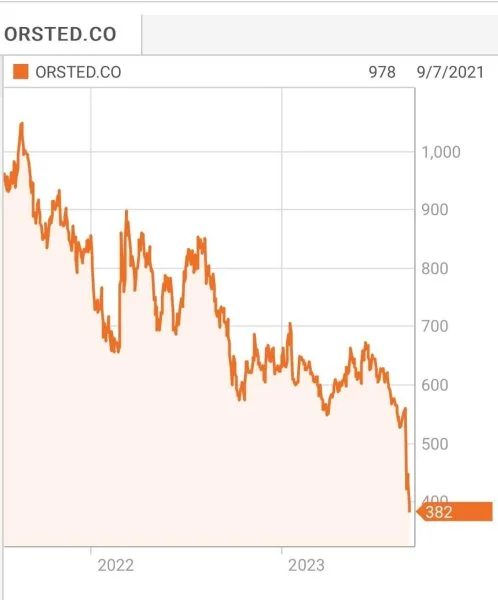
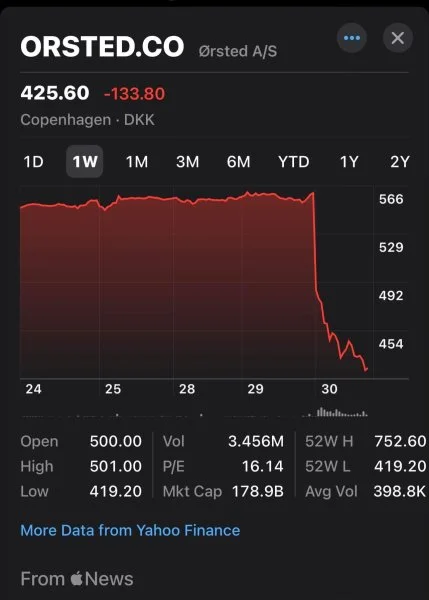
Shares of the world's largest offshore wind farm developer crashed in Copenhagen trading on Wednesday after it warned: "The situation in US offshore wind is severe."
Orsted A/S was hit with a massive 16 billion Danish kroner ($2.3 billion) impairment on its US portfolio due to snarled supply chains, soaring interest rates, and easy money tax credits drying up -- a warning sign the green energy revolution bubble is in trouble.
CEO Mads Nipper warned investors on a conference call: "The situation in US offshore wind is severe."
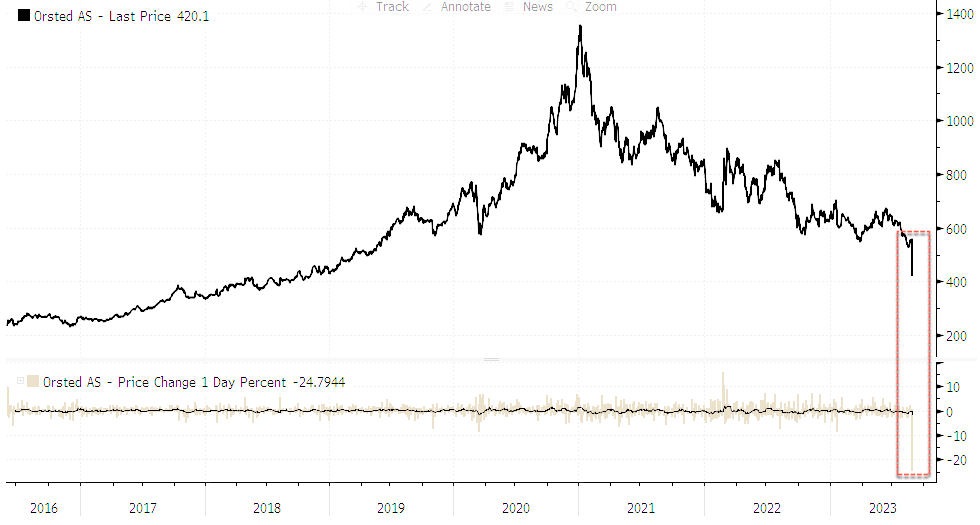
Shares in Denmark-listed green energy giant crashed 25%, the largest daily decline since it went public in early 2016.
Bloomberg explained more about the headwinds plaguing Orsted:
The company's Ocean Wind 1, Sunrise Wind, and Revolution Wind projects in the US are being hurt by supplier delays, which could lead to writedowns of up to 5 billion kroner, it said late Tuesday. High interest rates could also add another 5 billion. In addition, the developer is still in talks with federal stakeholders to qualify for additional tax credits, which haven't progressed as expected. If unsuccessful, it could lead to impairments of as much as 6 billion kroner.
Analysts at Bernstein warned clients in a note: "Today's announcement flags risks in the US portfolio and does not do anything to improve the downbeat investor sentiment on the stock."
"While the bulls could argue many of these issues related to the impairment are already known, the announcement is unlikely to bode well for an already-weakened Orsted share price," Citigroup Inc. analyst Jenny Ping told clients.
Analysts across the board were overwhelmingly pessimistic about the news (list courtesy of Bloomberg):
BNP Paribas Exane (cut to neutral from outperform)
The potential write-down of DKK16b dwarfs the DKK2.5b impairment announced in January, analyst Harry Wyburd writes in a note
Investor confidence will probably be "compromised" for some time
UBS (buy)
Sam Arie puts the focus on which targets will remain valid in this context
Says today's announcement is a negative and somewhat of a surprise
Adds investors may be concerned in the change in tone since the June CMD where management seemed more confident in regulatory changes that would help to protect the return profile of these US projects
Jefferies (buy)
The update is a "clear negative," analyst Ahmed Farman (buy) writes in a note
The impairments are equivalent to as much as ~7% of the Danish power generator's market capitalization
Still, Jefferies says recent share price weakness suggests the market hasn't priced in "much value" in the company's near- term US offshore pipeline
RBC (sector perform)
Alexander Wheeler also calls it a clear negative, with further doubt cast on the overall outlook for US projects, which many believed had been resolved at the capital market day
With ~$4bn invested in the US projects to date, the impairment of up to DKK 16bn ($2.4bn) represents just over half of the overall value
The DKK5b supplier charge is believed to be the maximum number, while on interest rates, if rates stay at current levels then the DKK 5b will be the impact booked at 9M
We ought to label Orsted's crash as the 'Green Panic.' Bulls eager to ride the climate energy revolution might want to rethink their mid-term views.
Long-finned pilot whales stop feeding and flee when they hear the sounds of danger.SAANA ISOJUNNO
When naval ships and other sea vessels use sonar, many whale species flee for their lives; some even strand themselves on beaches in a desperate attempt to escape. Now, scientists have discovered the most likely reason: The loud sounds trigger the same fear response as when the animals hear calls emitted by one of their most terrifying predators: killer whales.
“It’s a great study,” says Robin Baird, who investigates the effects of sonar on dolphins and whales (collectively known as cetaceans) at Cascadia Research Collective, a marine science nonprofit. The work should help scientists predict which species are most susceptible to humanmade sounds, says Baird, who was not involved with the project.
Scientists know some cetaceans, such as harbor porpoises and beaked whales, flee from sonar, whereas others, such as pilot whales, seem indifferent. To figure out why, Patrick Miller, a marine biologist at the University of St. Andrews, and colleagues attached sound and dive recording tags (with suction cups) to randomly chosen members of four whale species—sperm, humpback, long-finned pilot, and northern bottlenoses—in the Norwegian Sea, above the Arctic Circle. The team tracked the animals from a research vessel, then followed them in a smaller boat that was either silent or transmitted three types of sounds: sonar in the 1- to 4-kilohertz band (similar to naval sonar), and clicks emitted by two types of killer whales—those that eat fish exclusively and those that prey exclusively on marine mammals, including other cetaceans. (Although the two types of killer whale are not known to interbreed, they have not yet been identified as separate species.)
<h4>This piece was written by well know and respected VIRGINIA MORELL</h4>
George R. Scocca george@nyangler.com www.nyangler.com - Your Secret Spot Online !
The Inflation Reduction Act (IRA) includes hundreds of billions of dollars in subsidies for green energy, yet now renewable developers want utility rate-payers in New York and other states to bail them out.
According to a report late last month by the New York State Energy Research and Development Authority (Nyserda), large offshore wind developers are asking for an average 48% price adjustment in their contracts to cover rising costs. The Alliance for Clean Energy NY is also requesting an average 64% price increase on 86 solar and wind projects.
The IRA includes federal tax credits that can offset 50% of a project’s costs. But renewable developers say their costs are increasing faster than inflation and that the projects will “not be economically viable and would be unable to proceed to construction and operation under their existing pricing,” says Nyserda.
Irony alert: One reason is that the government-forced green energy transition is driving up demand for equipment, material and labor. “Growing demand for renewable energy projects nationwide ‘has exacerbated inflation for renewable project cost components relative to broader inflation levels,’” Nyserda says, citing the Alliance for Clean Energy NY.
The climate lobby says power from wind and solar is cheaper than from fossil fuels, but that’s true only with generous subsidies and near-zero interest rates. Price adjustments that renewable developers want in New York would make solar and wind two- to five-times more expensive than natural gas power.
Another irony: The IRA’s prevailing wage and domestic content conditions for bonus tax credits, which are necessary to make projects viable, inflate costs. That means U.S. taxpayers will pay more for the green corporate welfare, and utility ratepayers will pay more for renewable power. The climate lobby hits you coming and going.
Meantime, the computer chip maker Micron Technology recently disclosed that its planned factories in upstate New York, which are set to receive up to $5.5 billion in state subsidies, will consume as much power as New Hampshire and Vermont combined. Where will all the power come from?
The speed at which these projects blew up seems stunning. But it really isn’t.
EVs, solar, and wind projects don’t scale. Heck, they don’t scale even with subsidies. I have been saying this for months.
Needed minerals and skilled labor are in short supply. The US is still dependent on China and other foreign countries for materials.
Interesting, I seen that on the AM news; unfortunately it will get no traction. 😡 The spin doctors are hard at work. Wait till Orsted and others pull out and the bill falls on our kitchen table.
Interesting, I seen that on the AM news; unfortunately it will get no traction. 😡 The spin doctors are hard at work. Wait till Orsted and others pull out and the bill falls on our kitchen table.
We'll see what he presents next. It's straightforward: they green-lit the killing of whales. What more can be added? Rumor has it that Orstead continues their operations. I'm on the hunt for footage of their inaugural windmill installation. Word is, it's enormous! It would be compelling to see a united front obstructing their navigational territory. I'm not advocating for any actions - I don’t wish to be held accountable for such suggestions - but unity on this matter would be uplifting!
George R. Scocca george@nyangler.com www.nyangler.com - Your Secret Spot Online !




 Long-finned pilot whales stop feeding and flee when they hear the sounds of danger.SAANA ISOJUNNO