noreaster.com
Forum/The Anglers Lounge/the "Headline That Caught My Attention or the WTF" thread

the "Headline That Caught My Attention or the WTF" thread

390,386 views·6057 replies·by wader·First Post·Latest
wader
waderFREE2020#481

Sad................

*It’s possible Rivera’s last act was saving the life of her son.

Ayub said the boy told investigators they were swimming and his mother helped boost him onto the boat. When he looked back she was gone. The sheriff noted there are currents in Lake Piru, particularly in the afternoon, which is the time of day when she disappeared. Because the boat wasn’t anchored, it is possible that she “mustered enough energy to get her son back onto the boat, but not enough to save herself.”*
:cry:

[URL unfurl="true"]https://www.yahoo.com/entertainment/naya-rivera-dead-body-recovered-lake-piru-glee-disappearance-211414122.html[/URL]

"Well, it's alright.
.............even if you're old and gray."
"Well, it's alright.
............you still got something to say."
AdmiralOriginal Crew20,900 postsSince 2018
wader
waderFREE2020#482

very, very sad..................

*“Thank you to the men and women of the Ventura, Tulare, and San Luis Obispo County Sheriff’s Departments for your commitment and unwavering effort to find Naya. We extend endless gratitude and ovation to the heroine who found her. Thank you to her friends, colleagues, and fans for your continuous support,” they concluded. “Heaven gained our sassy angel. We kindly request that our privacy be respected during this very difficult time.”

Rivera, 33, went missing on July 8 at Lake Piru, about an hour outside of Los Angeles, Calif. The Glee star rented a pontoon boat for her and her 4-year-old son, Josey, but never returned from a swimming excursion with her boy. According to investigators, it’s believed [she saved her son’s life]('https://www.yahoo.com/entertainment/naya-rivera-saved-son-before-drowning-their-close-bond-171305981.html') over her own when the boat started to drift as there are currents in the lake in the afternoons.

“We believe it was mid-afternoon when she disappeared, the idea perhaps being that the boat started drifting — it was unanchored — and that she mustered enough energy to get her son back on to the boat, but not enough to save herself,” Ventura County Sheriff Bill Ayub shared at Monday’s press conference.

Rivera’s son told investigators that he and his mom had been swimming and that she “boosted him” onto the deck of the boat from behind. “He told investigators that he looked back and saw her disappear under the surface of the water,” Ayub noted.

*

"Well, it's alright.
.............even if you're old and gray."
"Well, it's alright.
............you still got something to say."
AdmiralOriginal Crew20,900 postsSince 2018
Roccus7
Roccus7MODnoreaster.com2020#483

From the "Headless Body In Topless Bar" NYPost Headline Files, but the NYTimes loses this round...

[[SIZE=6]Man’s Dismembered Body Is Found in Luxury Manhattan Condo[/SIZE]]('https://www.nytimes.com/2020/07/14/nyregion/dismembered-body-houston-street-manhattan.html?action=click&module=Latest&pgtype=Homepage')

Shall I go to heaven or a-fishing? - H. D. Thoreau
Veni. Vidi. Cepi. - with apologies to Gaius Julius Caesar
AdmiralOriginal Crew21,717 postsSince 2018
WhatKnot
WhatKnotFREE2020#484

From the "Headless Body In Topless Bar" NYPost Headline Files, but the NYTimes loses this round...

[[SIZE=6]Man’s Dismembered Body Is Found in Luxury Manhattan Condo[/SIZE]]('https://www.nytimes.com/2020/07/14/nyregion/dismembered-body-houston-street-manhattan.html?action=click&module=Latest&pgtype=Homepage')

WTF o_O

Be Safe
CommodoreOriginal Crew12,915 postsSince 2019
wader
waderFREE2020#485

[URL unfurl="true"]https://www.yahoo.com/sports/shaquille-o-neal-stops-to-help-driver-stranded-on-the-side-of-the-road-233303635.html[/URL]

"Well, it's alright.
.............even if you're old and gray."
"Well, it's alright.
............you still got something to say."
AdmiralOriginal Crew20,900 postsSince 2018
wader
waderFREE2020#486

[URL unfurl="true"]https://www.yahoo.com/news/black-leaders-call-nypd-bring-154707836.html[/URL]

"Well, it's alright.
.............even if you're old and gray."
"Well, it's alright.
............you still got something to say."
AdmiralOriginal Crew20,900 postsSince 2018
wader
waderFREE2020#487

[URL unfurl="true"]https://www.yahoo.com/news/un-official-catastrophe-looming-oil-235102956.html[/URL]

"Well, it's alright.
.............even if you're old and gray."
"Well, it's alright.
............you still got something to say."
AdmiralOriginal Crew20,900 postsSince 2018
wader
waderFREE2020#488

[URL unfurl="true"]https://www.yahoo.com/lifestyle/men-limit-alcohol-1-drink-223350496.html[/URL]

:oops::rolleyes::cautious::unsure::whistle::ROFLMAO::ROFLMAO::ROFLMAO::ROFLMAO::ROFLMAO::ROFLMAO::ROFLMAO::ROFLMAO::ROFLMAO::ROFLMAO::ROFLMAO::ROFLMAO::ROFLMAO:

yeah - right..........................
8-)

"Well, it's alright.
.............even if you're old and gray."
"Well, it's alright.
............you still got something to say."
AdmiralOriginal Crew20,900 postsSince 2018
Roccus7
Roccus7MODnoreaster.com2020#489

[SIZE=7]Two species of rare beaked whales beached in Maine within weeks of each other[/SIZE]
[pressherald.com/2020/07/16/two-species-of-rare-beaked-whales-beached-in-maine-within-weeks-of-each-other/]('https://www.pressherald.com/2020/07/16/two-species-of-rare-beaked-whales-beached-in-maine-within-weeks-of-each-other/')

By Hannah LaClaireTimes RecordJuly 16, 2020
[]('')
Lynda Doughty from Marine Mammals of Maine (left) and team members lift a 1,700 pound Sowerby’s beaked whale into the water last Saturday. Though they initially hoped for a positive outcome, the whale later died. Courtesy of Marine Mammals of Maine

Lynda Doughty was surprised when one of the ocean’s rarest and least understood whale species washed ashore in York last month, and even more astonished when another subspecies of the whale was stranded in Phippsburg just a few weeks later.

These whales, known as beaked whales for their long, beaked dolphin-like nose, are so elusive that there have been just four beaked whales documented in Maine waters in the past 20 years.

Sadly, the whale in York, a 14-foot, 2,200 pound Blainville’s beaked whale, was found deceased. The necropsy revealed she had recently given birth to a calf, but Doughty, director and founding member of Bath-based Marine Mammals of Maine, could not find any immediate cause of death.

The whale in Phippsburg, a 1,700 pound female Sowerby’s beaked whale, was found stranded in a mudflat during low tide in Atkins Bay near Popham Beach on Saturday.

Doughty’s team used stretchers and the tide to get the whale back in the water. However, despite no obvious signs of injury or illness, she was later found deceased and no cause of death has been identified.

Doughty doesn’t know what happened to the animals, or how they got to Maine, but she does know that they should not have been here.

“The fact that a beaked whale is in a coastal area is an alarm,” she said. “There’s a lot unknown about their general habitat use, but they should not be in coastal waters.”

Beaked whales are deep-water cetations (whales, dolphins, porpoises) that swim in deepwater canyons and continental slopes and can dive for up to 45 minutes and to depths of nearly 5,000 feet, depending on the species. They use suction to feed on deep-sea fish and squid while they dive.

According to the National Oceanic and Atmospheric Administration, Sowerby’s beaked whales, sometimes known as the “North Atlantic beaked whale” prefer the deep, cold, temperate and subarctic waters throughout the North Atlantic Ocean, while Blainville’s beaked whales, or the “dense-beaked whale” prefer tropical to temperate waters. The species lack distinguishable characteristics and can, therefore, be difficult to differentiate — Doughty said it took substantial research to identify the minute differences in skeletal structure, beak arc, color and flipper size to land on Sowerby’s and Blainville’s whales. The whole family is generally characterized as “cryptic” and “skittish,” according to NOAA.

There are 22 known species of beaked whales, but sightings are so infrequent that very little is known about their numbers, lifespans, or habits.

“They’re amazing animals,” said Rosemary Seton, marine mammal stranding coordinator at College of the Atlantic. Her organization responds to strandings from Rockland to Canada, whereas Marine Mammals of Maine responds to strandings from Rockland to Kittery.

Seton said there have not been any reported sightings of beaked whales in her area since the 1980s — a True’s beaked whale whose skeleton is on display at the college.

“That they had four in 20 years is amazing,” she said. “They’re a bit mysterious.”

There are numerous reasons a whale can become stranded, including illness, “acoustic trauma” from human noise and the use of sonar, old age and more.

But “usually something is amiss,” she said.

Doughty said the whale skeletons will be donated to the Smithsonian National Museum of Natural History to help scientists better understand the mysterious creatures.

“Anything we can do to gain more knowledge of (beaked whales) is helpful, and can provide future data and information,” and help track evolutionary changes, she said.

“It just goes to show … as much as we study our oceans, there’s still a lot to learn,” she said. “It makes you realize how big our ocean really is.”

Marine Mammals of Maine responds to about 300 reports of animal strandings per year — 90% of which are seals, and the remainder of which are dolphins, whales and porpoises, Daughty said. Stranded animals like whales, which cannot live outside of the water like seals can, are always an emergency situation, she said, but it is important not to try to move the animal back into the water.

“The longer that animal is out of the water, the more stress and impact (there is), but because they’re not righted in their normal position, the weight can be detrimental to them internally,” she said. Plus, because the animal does not know a person is there to help, they may try to protect themselves, which could be dangerous.

Shall I go to heaven or a-fishing? - H. D. Thoreau
Veni. Vidi. Cepi. - with apologies to Gaius Julius Caesar
AdmiralOriginal Crew21,717 postsSince 2018
wader
waderFREE2020#490

[URL unfurl="true"]https://www.yahoo.com/entertainment/billy-joel-proves-hes-still-204505472.html[/URL]

"Well, it's alright.
.............even if you're old and gray."
"Well, it's alright.
............you still got something to say."
AdmiralOriginal Crew20,900 postsSince 2018
Roccus7
Roccus7MODnoreaster.com2020#491

A feel good article...

[SIZE=7]Queen makes ‘Capt. Tom’ a knight at 100. No kneeling was required.[/SIZE]
[pressherald.com/2020/07/17/queen-makes-capt-tom-a-knight-at-100-no-kneeling-was-required/]('https://www.pressherald.com/2020/07/17/queen-makes-capt-tom-a-knight-at-100-no-kneeling-was-required/')

By DANICA KIRKAAssociated PressJuly 17, 2020
[IMG alt="Capt. Sir Thomas Moore receives his knighthood from Britain's Queen Elizabeth during a ceremony at Windsor Castle in Windsor, England, on Friday. Sir Tom raised about $40 million for health service charities by walking laps of his Bedfordshire garden. "]https://multifiles.pressherald.com/uploads/sites/10/2020/07/APTOPIX_Virus_Outbreak_Britain_63004-1.jpg[/IMG]

LONDON — In the end, Sir Tom didn’t need to rise.

On a day infused with emotion, Queen Elizabeth II tapped the blade of a sword once owned by her father on the slender shoulders of 100-year-old Tom Moore, making a hero of a nation a knight of the realm Friday.

Moore captivated the British public by walking 100 laps of his garden in England and raising some 33 million pounds ($40 million) for the National Health Service in April. The queen knighted him with the traditional sword tap, but the World War II veteran was not required to take a knee before the monarch.

Instead, Moore steadied himself against his now-famous walker and wheeled himself across the grass to stand in front of Elizabeth.

“I have been overwhelmed by the many honours I have received over the past weeks, but there is simply nothing that can compare to this,” he tweeted after the ceremony. “I am overwhelmed with pride and joy.“

The ceremony was staged outside of Windsor Castle west of London, where the 94-year old queen has been sheltering during the COVID-19 pandemic alongside her husband, the Duke of Edinburgh.

Moore, who rose to the rank of captain while serving in India and Burma during the war, revealed that he and Elizabeth spoke about ages – slightly breaking the protocol of not revealing a private conversation with the queen.

“She did mention I’m 100, and I said to her, ‘Well, you’ve a long way to go yet,’ so she’s alright,” he said.
Moore walked into the nation’s hearts by setting a goal of marking his 100th birthday with a garden lap for each year of his life.

His family elevated the challenge by using social media and the motto #TomorrowWillBeAGoodDay to seek donations to support health care workers during the pandemic, in part a show of gratitude for the doctors and nurses who took care of Moore when he broke his hip last year.

He dreamed of raising 1,000 pounds. Instead, he raised so much more.

Shall I go to heaven or a-fishing? - H. D. Thoreau
Veni. Vidi. Cepi. - with apologies to Gaius Julius Caesar
AdmiralOriginal Crew21,717 postsSince 2018
Roccus7
Roccus7MODnoreaster.com2020#492

Ah Natural Selection...

[SIZE=7]How Ultra-Black Fish Disappear in the Deepest Seas[/SIZE]
Researchers have found fish that absorb more than 99.9 percent of the light that hits their skin.

Alexander Davis admits that he can be a glutton for punishment. He staked part of his Ph.D. on finding some of the world’s best-camouflaged fishes in the ocean’s deepest depths. These animals are so keen on not being found that they’ve evolved the ability to absorb more than 99.9 percent of the light that hits their skin.

To locate and study these so-called ultra-black fishes, Mr. Davis, a biologist at Duke University, said he relied largely on the luck of the draw. “We basically just drop nets and see what we get,” he said. “You never know what you’re going to pull up.”

When he and his colleagues did cash in, they cashed in big. In a paper published Thursday in [Current Biology]('http://dx.doi.org/10.1016/j.cub.2020.06.044'), they report snaring the first documented ultra-black animals in the ocean, and some of the darkest creatures ever found: 16 types of deep-sea fish that are so black, they manifest as permanent silhouettes — light-devouring voids that almost seem to shred the fabric of space-time.

“It’s like looking at a black hole,” Mr. Davis said.

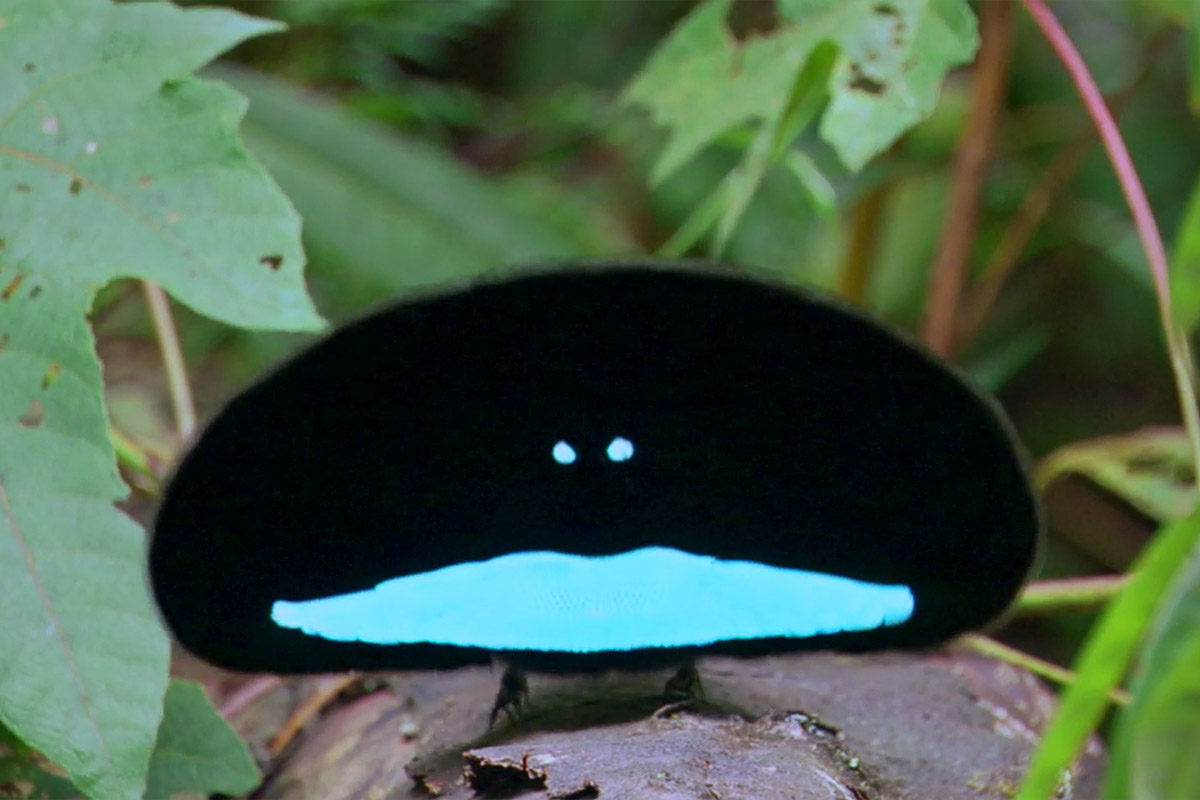
To qualify as [ultra-black]('https://www.nytimes.com/2019/11/11/science/black-fashion-physics-animals.html'), a substance has to reflect less than 0.5 percent of the light that hits it. Some [birds of paradise]('') manage this, beaming back [as little as 0.05 percent]('https://www.nature.com/articles/s41467-017-02088-w'), as do certain types of [butterflies]('https://www.nature.com/articles/s41467-020-15033-1') (0.06 percent) and [spiders]('https://royalsocietypublishing.org/doi/10.1098/rspb.2019.0589') (0.35 percent). A feat of engineering allowed humans to best them all with [synthetic materials]('https://www.pnas.org/content/106/15/6044'), some of which reflect only 0.045 percent of incoming light. (“Black” paper, on the other hand, returns a whopping 10 percent of the light it meets.)

Now, it seems fish may come close to trouncing them all.

One species profiled in the paper, a bioluminescent anglerfish in the genus Oneirodes, reflects as little as 0.044 to 0.051 percent of the deep-sea light it encounters. The other 99.95 percent, Mr. Davis and his colleagues found, gets lost in a labyrinth of light-swallowing pigments until it effectively disappears.

“I’m always arguing with bird people on the internet,” said Kory Evans, a fish biologist at Rice University who wasn’t involved in the study. “I say, ‘I bet these deep-sea fish are as dark as your birds of paradise.’ And then boom, they checked, and that was exactly the case.”

Super-dark skin might seem redundant hundreds or thousands of feet beneath the surface of the sea, where the sun’s rays don’t reach. But thanks to the D.I.Y. light cooked up by bioluminescent creatures, this part of the ocean can actually “sparkle like the sky,” said Prosanta Chakrabarty, a fish biologist at Louisiana State University who wasn’t involved in the study.

Birds, butterflies and spiders tend to use ultra-black for contrast, making vibrant patches of color pop against an extreme backdrop. Some fish may do this, too. But in a world where many deep-sea lurkers use their homemade glow to lure in prey, ultra-black may function more as a disappearing act for swimmers that don’t want to be spotted, Dr. Evans said.

To suss out how deep-sea fishes conjure their cloaks of invisibility, the researchers took skin samples from nine species of ultra-black fish and analyzed them under the microscope.

Like many other animals, including humans, fish pigment their skin with melanin, a light-absorbing compound stored in microscopic compartments called melanosomes. Typically colored fish scatter these pockets of pigment into a sparse, even layer held up by a protein called collagen. Any light that hits the melanin head-on is gobbled up, while light that misses the mark ricochets back toward the viewer.

To maintain their stealth, the researchers found, ultra-black fishes skimp on the collagen. That allows them to pack their melanosomes together like piled grains of rice. When light contacts the clutter, what’s not absorbed is deflected sideways — straight into the path of another ravenous melanosome.

Ultra-black birds, butterflies and spiders do something similar, but perhaps in a less efficient way, said Karen Osborn, a zoologist at the Smithsonian National Museum of Natural History and an author on the study, which she began in 2014. Rather than using the same structure — melanosomes — to absorb and deflect light, as fish do, these land-living animals embed their melanin in mazes of bumps, boxes or spikes that bounce photons back and forth. What deep-sea fish do “is a much simpler system,” Dr. Osborn said.

That could be a saving grace for creatures that must eke out a living in an environment as harsh and unforgiving as the deep sea, said Anela Choy, a deep-sea researcher at the Scripps Institution of Oceanography in San Diego who wasn’t involved in the study.

Down there, Dr. Choy said, everything “has to do with survival: eating, not being eaten and reproducing yourself.”

Some of the ocean’s deepest dwellers might be even darker than what Mr. Davis and colleagues have dredged up.

“I would not be surprised if we have not yet found the blackest fish in the sea,” Dr. Chakrabarty said.

Shall I go to heaven or a-fishing? - H. D. Thoreau
Veni. Vidi. Cepi. - with apologies to Gaius Julius Caesar
AdmiralOriginal Crew21,717 postsSince 2018
wader
waderFREE2020#493

Ah Natural Selection...

[SIZE=7]How Ultra-Black Fish Disappear in the Deepest Seas[/SIZE]
Researchers have found fish that absorb more than 99.9 percent of the light that hits their skin.

Alexander Davis admits that he can be a glutton for punishment. He staked part of his Ph.D. on finding some of the world’s best-camouflaged fishes in the ocean’s deepest depths. These animals are so keen on not being found that they’ve evolved the ability to absorb more than 99.9 percent of the light that hits their skin.

To locate and study these so-called ultra-black fishes, Mr. Davis, a biologist at Duke University, said he relied largely on the luck of the draw. “We basically just drop nets and see what we get,” he said. “You never know what you’re going to pull up.”

When he and his colleagues did cash in, they cashed in big. In a paper published Thursday in [Current Biology]('http://dx.doi.org/10.1016/j.cub.2020.06.044'), they report snaring the first documented ultra-black animals in the ocean, and some of the darkest creatures ever found: 16 types of deep-sea fish that are so black, they manifest as permanent silhouettes — light-devouring voids that almost seem to shred the fabric of space-time.

“It’s like looking at a black hole,” Mr. Davis said.

To qualify as [ultra-black]('https://www.nytimes.com/2019/11/11/science/black-fashion-physics-animals.html'), a substance has to reflect less than 0.5 percent of the light that hits it. Some [birds of paradise]('') manage this, beaming back [as little as 0.05 percent]('https://www.nature.com/articles/s41467-017-02088-w'), as do certain types of [butterflies]('https://www.nature.com/articles/s41467-020-15033-1') (0.06 percent) and [spiders]('https://royalsocietypublishing.org/doi/10.1098/rspb.2019.0589') (0.35 percent). A feat of engineering allowed humans to best them all with [synthetic materials]('https://www.pnas.org/content/106/15/6044'), some of which reflect only 0.045 percent of incoming light. (“Black” paper, on the other hand, returns a whopping 10 percent of the light it meets.)

Now, it seems fish may come close to trouncing them all.

One species profiled in the paper, a bioluminescent anglerfish in the genus Oneirodes, reflects as little as 0.044 to 0.051 percent of the deep-sea light it encounters. The other 99.95 percent, Mr. Davis and his colleagues found, gets lost in a labyrinth of light-swallowing pigments until it effectively disappears.

“I’m always arguing with bird people on the internet,” said Kory Evans, a fish biologist at Rice University who wasn’t involved in the study. “I say, ‘I bet these deep-sea fish are as dark as your birds of paradise.’ And then boom, they checked, and that was exactly the case.”

Super-dark skin might seem redundant hundreds or thousands of feet beneath the surface of the sea, where the sun’s rays don’t reach. But thanks to the D.I.Y. light cooked up by bioluminescent creatures, this part of the ocean can actually “sparkle like the sky,” said Prosanta Chakrabarty, a fish biologist at Louisiana State University who wasn’t involved in the study.

Birds, butterflies and spiders tend to use ultra-black for contrast, making vibrant patches of color pop against an extreme backdrop. Some fish may do this, too. But in a world where many deep-sea lurkers use their homemade glow to lure in prey, ultra-black may function more as a disappearing act for swimmers that don’t want to be spotted, Dr. Evans said.

To suss out how deep-sea fishes conjure their cloaks of invisibility, the researchers took skin samples from nine species of ultra-black fish and analyzed them under the microscope.

Like many other animals, including humans, fish pigment their skin with melanin, a light-absorbing compound stored in microscopic compartments called melanosomes. Typically colored fish scatter these pockets of pigment into a sparse, even layer held up by a protein called collagen. Any light that hits the melanin head-on is gobbled up, while light that misses the mark ricochets back toward the viewer.

To maintain their stealth, the researchers found, ultra-black fishes skimp on the collagen. That allows them to pack their melanosomes together like piled grains of rice. When light contacts the clutter, what’s not absorbed is deflected sideways — straight into the path of another ravenous melanosome.

Ultra-black birds, butterflies and spiders do something similar, but perhaps in a less efficient way, said Karen Osborn, a zoologist at the Smithsonian National Museum of Natural History and an author on the study, which she began in 2014. Rather than using the same structure — melanosomes — to absorb and deflect light, as fish do, these land-living animals embed their melanin in mazes of bumps, boxes or spikes that bounce photons back and forth. What deep-sea fish do “is a much simpler system,” Dr. Osborn said.

That could be a saving grace for creatures that must eke out a living in an environment as harsh and unforgiving as the deep sea, said Anela Choy, a deep-sea researcher at the Scripps Institution of Oceanography in San Diego who wasn’t involved in the study.

Down there, Dr. Choy said, everything “has to do with survival: eating, not being eaten and reproducing yourself.”

Some of the ocean’s deepest dwellers might be even darker than what Mr. Davis and colleagues have dredged up.

“I would not be surprised if we have not yet found the blackest fish in the sea,” Dr. Chakrabarty said.

saw that yesterday - interesting read

"Well, it's alright.
.............even if you're old and gray."
"Well, it's alright.
............you still got something to say."
AdmiralOriginal Crew20,900 postsSince 2018
wader
waderFREE2020#494

[URL unfurl="true"]https://www.yahoo.com/news/10-old-boy-dragged-off-210313275.html[/URL]

"Well, it's alright.
.............even if you're old and gray."
"Well, it's alright.
............you still got something to say."
AdmiralOriginal Crew20,900 postsSince 2018
jpd
jpdMODnoreaster.com2020#495

[URL unfurl="true"]https://www.yahoo.com/news/10-old-boy-dragged-off-210313275.html[/URL]

An abalone diver who witnessed the horrifying ordeal described how the monster shark grabbed the boy.
***

'All of a sudden the shark leapt clean out of the water, hit the side of the boat and snapped the rod clean off in the rod holder,' Ben Allen told 9News.

***
'It grabbed the boy all in the one swipe … and pulled him into the water.'

A lawyer with his briefcase can steal more than a hundred men with guns- Mario Puzo
CommodoreOriginal Crew9,876 postsSince 2018
wader
waderFREE2020#496

sometimes I just don't know........................
:rolleyes:

[URL unfurl="true"]https://www.yahoo.com/entertainment/trump-boasts-putting-lot-more-182928025.html[/URL]

"Well, it's alright.
.............even if you're old and gray."
"Well, it's alright.
............you still got something to say."
AdmiralOriginal Crew20,900 postsSince 2018
wader
waderFREE2020#497

[URL unfurl="true"]https://www.yahoo.com/news/meet-sturddlefish-hybrid-two-living-152155579.html[/URL]

*Hungarian researchers accidentally created a hybrid of two "living fossils," the Russian sturgeon and the American paddlefish, according to a new study.

Researchers were trying to produce sturgeon offspring through gynogenesis, a system of asexual production that requires the presence of sperm but not the actual contribution of paternal DNA,[ according to the study published in the journal Genes.]('https://www.mdpi.com/2073-4425/11/7/753') Paddlefish sperm was used on the negative control group when it "unexpectedly" fertilized the sturgeon eggs.*
==========================
Why are they doing stuff like this in 2020?
Don't we have enough crap going wrong?

"Well, it's alright.
.............even if you're old and gray."
"Well, it's alright.
............you still got something to say."
AdmiralOriginal Crew20,900 postsSince 2018
Capt13
Capt13FREE2020#498

[URL unfurl="true"]https://www.yahoo.com/news/meet-sturddlefish-hybrid-two-living-152155579.html[/URL]

Why are they doing stuff like this in 2020?
Don't we have enough crap going wrong?

They'll probably grow to 1000 lbs and develop a taste for human flesh !!

:oops:

;)

“The greatest things ever done on earth have been done little by little"
CaptainOriginal Crew2,530 postsSince 2018
Roccus7
Roccus7MODnoreaster.com2020#499

They'll probably grow to 1000 lbs and develop a taste for human flesh !!

:oops:

;)

As long as their roe is as tasty as Beluga caviar, I don't care...

Shall I go to heaven or a-fishing? - H. D. Thoreau
Veni. Vidi. Cepi. - with apologies to Gaius Julius Caesar
AdmiralOriginal Crew21,717 postsSince 2018
wader
waderFREE2020#500

As long as their roe is as tasty as Beluga caviar, I don't care...

till one of 'em drags you off of your boat..........

"Well, it's alright.
.............even if you're old and gray."
"Well, it's alright.
............you still got something to say."
AdmiralOriginal Crew20,900 postsSince 2018

Sign in to reply to this thread.

Thread
the "Headline That Caught My Attention or the WTF" thread
Sign in